Ultimate Roadmap to Master Android Development using Flutter
A
AdminMay 11, 2026
4 min read
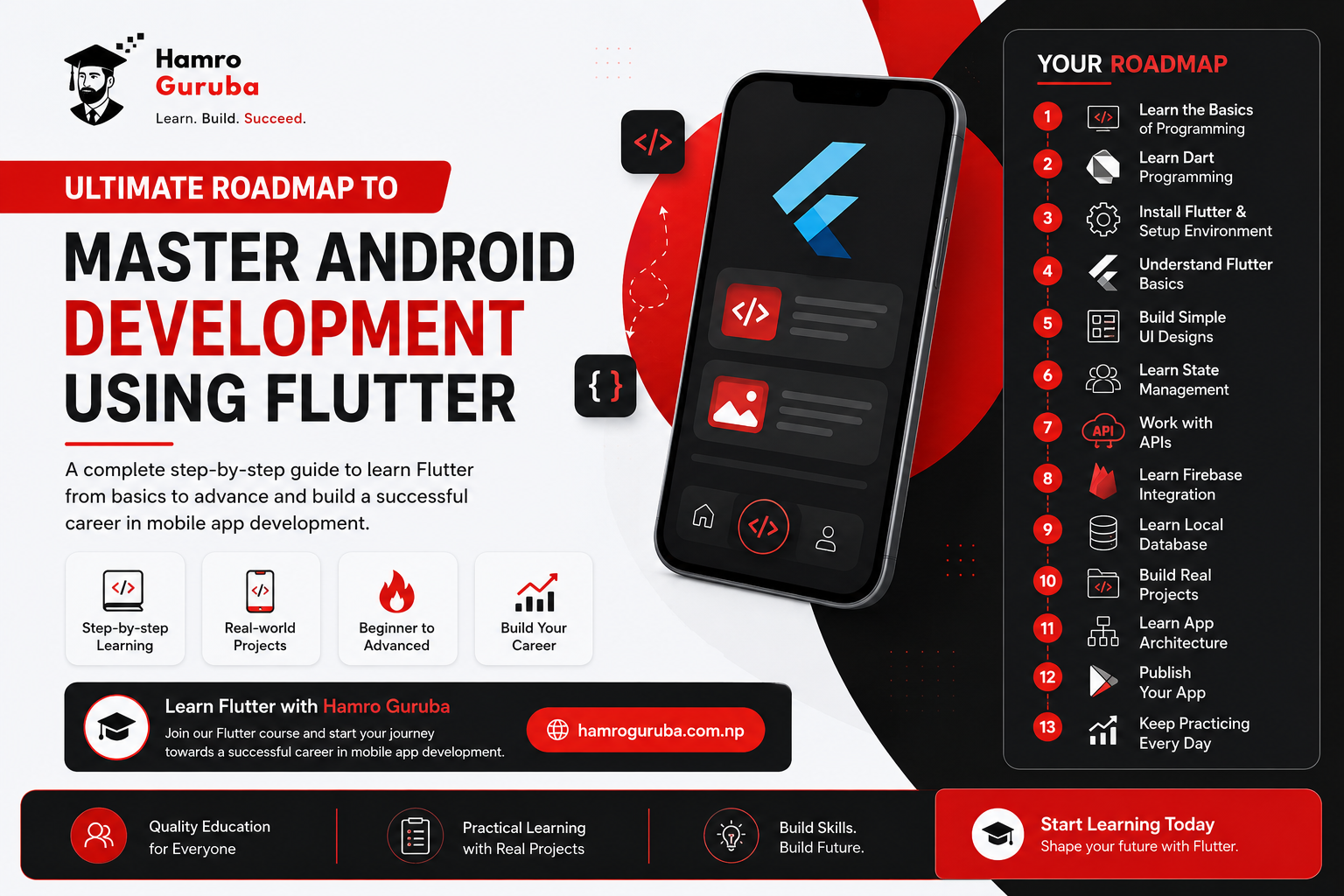
# Ultimate Roadmap to Master Android Development using Flutter | Hamro Guruba
Mobile app development is evolving rapidly, and Flutter has emerged as one of the most powerful frameworks for building Android applications. If you are planning to start your journey as an Android developer, Flutter is one of the most effective tools you can learn today.
At Hamro Guruba Pvt. Ltd., the belief is that anyone can learn mobile app development with the right roadmap, consistent practice, and proper guidance. This roadmap is designed to help beginners understand Android development using Flutter in a clear and structured way.
To begin with, it is important to first understand programming fundamentals before jumping into Flutter. Concepts such as variables, functions, loops, conditions like if and else, lists, maps, and object-oriented programming form the foundation of software development. Since Flutter is built using Dart, learning Dart becomes the first essential step in this journey.
Once the basics are clear, the next step is mastering Dart programming. You should focus on data types, functions, classes, objects, null safety, asynchronous programming using Future and async/await, and streams. Regular practice of Dart helps in building strong logic and makes Flutter development much easier to understand.
After that, setting up the development environment is necessary. This includes installing the Flutter SDK, Android Studio, and optionally VS Code, along with an Android emulator for testing applications. Once setup is complete, running the command “flutter doctor” ensures that the environment is properly configured and ready for development.
Flutter itself is built entirely around widgets, so understanding widgets is a crucial milestone. Concepts such as stateless and stateful widgets, containers, rows and columns, text widgets, buttons, images, and navigation form the core of UI development. At Hamro Guruba Pvt. Ltd., these concepts are taught in a step-by-step and beginner-friendly manner to make learning easier.
After gaining basic knowledge, practicing UI design becomes important. Simple projects such as login screens, registration forms, profile pages, calculator apps, and dashboards help improve both design and coding skills at the same time. These small projects build confidence for larger applications.
The next important concept is state management, which controls how data changes in an app. Methods such as setState, Provider, Riverpod, and Bloc are commonly used, with Provider being one of the easiest options for beginners.
Modern applications also rely heavily on APIs, so learning how to work with REST APIs, JSON data, HTTP requests, and online data fetching is essential. This knowledge can be applied by building apps like weather apps, news apps, or movie browsing applications.
Another powerful tool in Flutter development is backend integration using Firebase. It provides services like authentication, Firestore database, storage, and push notifications, making it easier to build fully functional applications without managing complex backend systems.
Along with online data, offline storage is also important in mobile applications. Technologies such as shared preferences, SQLite, and Hive allow apps to store data locally on the device, even without an internet connection.
Once these concepts are clear, building real-world projects becomes the most important learning stage. Projects like e-commerce apps, chat applications, school management systems, expense trackers, and food delivery apps help in applying all the knowledge in practical scenarios. At Hamro Guruba Pvt. Ltd., project-based learning is strongly encouraged to help learners gain real experience.
As applications grow in size, understanding app architecture becomes necessary. Concepts like clean architecture, MVVM pattern, reusable components, and proper folder structure help in writing clean, scalable, and professional code.
After completing development, the final step is publishing the application. Apps can be released on platforms such as Google Play Store, which involves generating APK or app bundles, signing the application, and optimizing the listing for users.
Finally, continuous learning is essential in the field of technology. Regular practice, following Flutter documentation, watching tutorials, contributing to open-source projects, and engaging with developer communities helps in staying updated and improving skills over time.
In conclusion, Flutter is one of the most powerful and in-demand technologies for Android development today. With consistent effort and the right learning path, anyone can become a skilled Flutter developer. Following this roadmap and practicing regularly can open the door to a successful career in mobile app development, especially with proper guidance from Hamro Guruba Pvt. Ltd..
Share this story:
Back to Blog